Dry Brine the Chicken: Place the chicken breasts on a cutting board and pat them completely dry with paper towels. Sprinkle 1 teaspoon of kosher salt and 0.5 teaspoon of black pepper evenly across both sides of each breast. Set the seasoned chicken on a wire rack over a rimmed baking sheet and leave it uncovered at room temperature for 30 minutes. The salt draws surface moisture out of the meat, which evaporates during the rest period and produces a drier exterior that sears rather than steams.
Slice the Chicken: Place each rested chicken breast flat on the cutting board. Hold the breast steady with your palm and cut horizontally through the center of the breast to create two even cutlets of uniform thickness, approximately 1.5cm / 0.6in each. Cut each cutlet crosswise into strips approximately 2.5cm / 1in wide. Uniform strips ensure even cooking and allow the chicken to finish at the same time as the pasta sauce.
Boil the Pasta: Fill a large pasta pot with 4 liters / 1 gallon of water and bring it to a rolling boil over high heat. Add 1 tablespoon of kosher salt to the boiling water, then add 300g / 10.5oz of dry penne rigate. Cook the penne for 7 minutes, stirring once at the 3-minute mark, until the pasta is al dente with a firm bite at its core. Reserve 120ml / 0.5 cup of pasta cooking water before draining the penne through a colander. Do not rinse the pasta.
Sear the Chicken Strips: Heat 1 tablespoon of olive oil in a 12-inch stainless steel skillet over medium-high heat for 90 seconds until the oil shimmers and a small drop of water evaporates on contact. Add the chicken strips in a single layer, working in two batches if needed to avoid crowding the pan. Cook the first side for 3 minutes without moving the strips until a golden-brown crust forms and the chicken releases cleanly from the pan. Flip each strip and cook the second side for 2 minutes until the internal temperature reads 74°C / 165°F on an instant-read thermometer. Transfer the cooked strips to a clean plate and tent loosely with foil.
Build the Pan Sauce: Reduce the heat to medium and add the remaining 1 tablespoon of olive oil to the same skillet. Add the 4 sliced garlic cloves and the red pepper flakes to the residual oil and fond. Stir constantly with a wooden spoon for 90 seconds until the garlic turns pale gold and fragrant. Pour in 60ml / 0.25 cup of dry white wine and scrape the browned fond from the bottom of the skillet with the wooden spoon. Let the wine reduce for 2 minutes until the sharp alcohol aroma dissipates and approximately half the liquid remains.
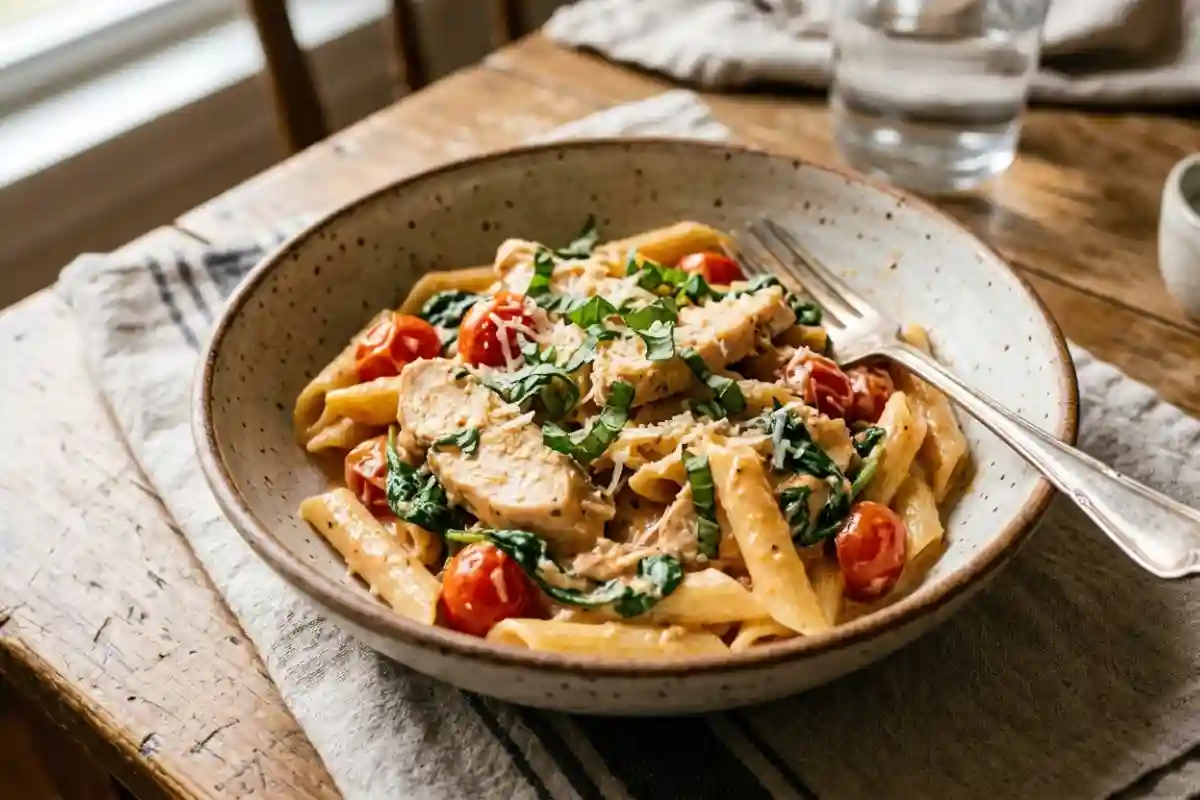
Finish with Stock and Pasta: Pour 240ml / 1 cup of low-sodium chicken stock into the skillet and bring the sauce to a simmer over medium heat for 3 minutes until the liquid reduces by one-third and coats the back of a spoon. Add the drained penne to the skillet along with the cooked chicken strips and 30g / 1oz of baby spinach. Toss everything together using tongs for 1 minute until the spinach wilts completely and each piece of pasta is coated in the sauce. Add reserved pasta water, 2 tablespoons at a time, if the sauce appears too thick.
Emulsify and Serve: Remove the skillet from heat. Add 1 tablespoon of unsalted butter and 30g / 1oz of grated Parmigiano-Reggiano to the skillet. Toss vigorously with tongs for 30 seconds until the butter melts completely and the cheese dissolves into the sauce, creating a glossy, cohesive coating on the pasta and chicken. Divide the chicken pasta evenly among four shallow bowls and top each portion with freshly chopped flat-leaf parsley.