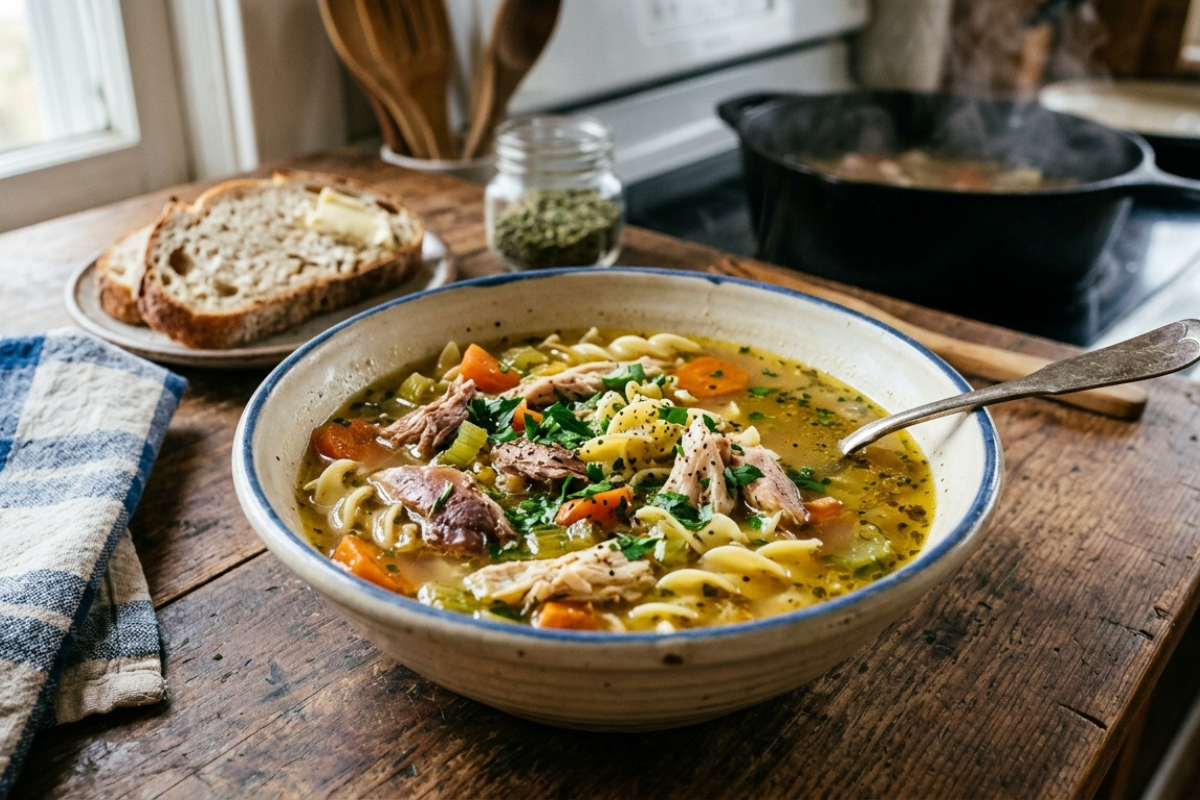
Chicken soup is a broth-based dish built from simmered whole chicken pieces, aromatic vegetables, and fresh herbs. It belongs to the broader category of clear soups and has roots in nearly every global cuisine, with the American home-cooking tradition centering on a straightforward stovetop method using bone-in chicken, celery, carrots, and onion. The long, gentle simmer draws collagen and gelatin from the bones, producing a broth with a silky body and deep, savory flavor.
A standard serving of chicken soup delivers roughly 28 grams of protein while keeping calories between 220 and 260, making it a practical choice for high-protein, gluten-free meal planning. It suits anyone recovering from illness, managing a calorie-conscious diet, or looking for a reliable weekend meal-prep staple. The dish scales easily, stores well, and reheats without losing quality, which is why it appears in so many weekly rotation menus.
If you enjoy building flavor through long simmers, the techniques here carry directly into dishes like chicken stock and chicken noodle soup, both of which share the same foundational method.
Chicken Soup
Ingredients
Equipment
Method
- Sear the Chicken: Heat the olive oil in a 7-quart stockpot or Dutch oven over medium-high heat until the oil shimmers and a faint haze rises from the surface, about 2 minutes. Add the chicken pieces skin-side down in a single layer, working in batches if needed to avoid crowding the pot. Sear undisturbed for 4 minutes until the skin turns a deep golden brown and releases naturally from the surface. Flip and sear the second side for 2 minutes, then transfer the chicken to a plate. This step builds a fond on the bottom of the pot, which will dissolve into the broth and deepen its savory character.
- Sweat the Aromatics: Reduce the heat to medium and add the halved onion cut-side down to the same pot, along with the smashed garlic cloves. Cook without stirring for 3 minutes until the onion faces take on a golden-brown color and the garlic softens and becomes fragrant. Add the celery, parsley stems, bay leaves, thyme sprigs, and black peppercorns, then stir to coat everything in the residual fat. Cooking the aromatics in the same pot lifts the browned fond from the sear and begins layering the flavor base before any liquid is added.
- Build the Broth: Return the seared chicken to the pot, nestling the pieces among the aromatics. Pour in the 2.2 liters of cold water, which should just cover the chicken by about 2cm / 0.75in. Stir in 1.5 teaspoons of fine sea salt and bring the liquid to a full boil over high heat, about 10 minutes. As the broth heats, use a large slotted spoon to skim off any gray foam that rises to the surface, which contains proteins and impurities that would cloud the finished broth.
- Simmer the Soup: Once the broth reaches a boil and has been skimmed clean, reduce the heat to low so the liquid maintains a gentle, steady simmer with small bubbles breaking the surface. Partially cover the pot with a lid and cook for 60 minutes, adjusting the heat occasionally to keep the simmer consistent and prevent a rolling boil, which would make the broth cloudy. After 60 minutes, the chicken should be fully cooked and very tender; confirm by checking that the thickest piece reads at least 74°C / 165°F on an instant-read thermometer. A slow simmer rather than a hard boil is what keeps the broth clear, golden, and full-bodied.
- Pull and Shred the Chicken: Use a slotted spoon or tongs to lift the chicken pieces out of the broth and transfer them to a cutting board. Allow the chicken to cool for 10 minutes until comfortable to handle. Pull the meat from the bones using two forks, discarding the skin, bones, and any cartilage. Shred the meat into bite-sized pieces, about 3cm / 1.2in lengths, and set aside.
- Strain and Return the Broth: Set a fine-mesh strainer over a large heatproof bowl or secondary pot and carefully pour the broth through it to remove the spent aromatics, herb stems, peppercorns, and onion. Discard the solids. Pour the strained, clear broth back into the original pot and return it to medium heat. Taste the broth at this stage and adjust the salt level before adding the vegetables.
- Cook the Vegetables: Add the sliced carrots and potato cubes to the strained broth and bring the liquid back to a simmer over medium heat, about 4 minutes. Cook for 15 minutes, then add the sliced celery. Continue simmering for another 5 minutes until the carrots are fully tender and yield easily when pierced with a fork, the potatoes hold their shape but are cooked through, and the celery has softened while retaining a slight bite. The total vegetable cook time is 20 minutes at a steady simmer of approximately 95°C / 203°F.
- Finish and Serve: Return the shredded chicken to the pot and stir to distribute it evenly through the broth. Simmer for 3 minutes to heat the chicken through completely. Remove the bay leaves if they are still present in the pot, then tear the reserved fresh parsley leaves and scatter them over the surface of the soup. Ladle into deep bowls and serve immediately while the broth is steaming hot.
Notes
- Storage: Transfer cooled soup to an airtight container and refrigerate for up to 4 days. The broth will gel when cold due to its natural gelatin content, which is normal; it will return to liquid form as it reheats.
- Reheating: Pour the desired portion into a small saucepan and warm over medium heat for 8 minutes, stirring occasionally, until the broth is steaming and the internal temperature of the chicken pieces reaches 74°C / 165°F. Avoid boiling during reheating, as vigorous heat can make the chicken stringy.
- Freezing: Ladle cooled soup into quart-sized freezer-safe containers, leaving 3cm / 1in of headspace for expansion, and freeze for up to 3 months. Thaw overnight in the refrigerator, then reheat on the stovetop as directed above. Note that potatoes can become mealy after freezing; if you plan to freeze the soup, omit the potatoes and add freshly cooked ones after thawing.
- Make-Ahead: The broth can be made through step 6 up to 2 days in advance and stored in an airtight container in the refrigerator. Skim the solidified fat layer from the surface of the chilled broth before proceeding with the vegetable-cooking steps, which takes less than 5 minutes.
- Substitution: Bone-in chicken breast halves can replace thighs and drumsticks entirely, though the resulting broth will be slightly less rich. If using boneless skinless chicken breasts, reduce the simmer time in step 4 to 40 minutes and verify the internal temperature reaches 74°C / 165°F before pulling the meat.
- Equipment Note: A Dutch oven with a heavy base distributes heat more evenly than a standard stockpot, which helps maintain a consistent simmer during the 60-minute broth stage. If using a thin-walled pot, check the heat level every 15 minutes and adjust the burner to prevent a hard boil.
FAQ
What cut of chicken is best for chicken soup?
Bone-in, skin-on chicken pieces produce the most flavorful and gelatinous broth because the bones release collagen during the long simmer, which gives the liquid body and a silky texture. Thighs and drumsticks are particularly effective because their higher fat content keeps the meat moist even after 60 minutes of cooking. Breast halves on the bone are leaner and work well when added to a mix of darker pieces, but a batch made with breast meat alone tends to yield a thinner broth. Using a whole chicken cut into parts is the most economical and flavor-rich approach, as it includes the back and neck bones, which are especially collagen-dense.
How do you keep chicken soup broth clear?
The key to a clear, golden broth is controlling heat and skimming diligently during the first 15 minutes of cooking. A hard, rolling boil agitates the liquid so vigorously that it suspends fat droplets and protein particles throughout, producing a cloudy, murky result. Instead, after the initial boil and skim, reduce the heat to a gentle simmer where small bubbles rise slowly and steadily. Using cold water at the start rather than hot tap water also helps, as it allows proteins to coagulate gradually and rise to the surface where they can be removed before they disperse through the broth.
How long should you simmer chicken soup?
For bone-in chicken pieces, a minimum simmer time of 60 minutes at a gentle heat of approximately 93°C to 96°C / 200°F to 205°F is needed to fully cook the meat and extract meaningful gelatin and flavor from the bones. Simmering for up to 90 minutes will deepen the broth flavor further without making the meat unpleasantly stringy, provided the heat stays low. If you extend the simmer beyond 90 minutes, the breast meat in particular can become dry and fibrous, so it is worth removing breast pieces at the 60-minute mark if using a mixed-cut approach. An instant-read thermometer confirming 74°C / 165°F at the thickest point is the reliable way to know the chicken is fully cooked regardless of timing.
Can you make chicken soup in a slow cooker?
Chicken soup translates well to a slow cooker, though the process requires a few adjustments. Add the seared chicken pieces, aromatics, and 1.75 liters of water to a 6-quart slow cooker, then cook on the low setting for 7 hours or on the high setting for 4 hours. Because slow cookers trap all moisture, the broth may taste slightly diluted compared to a stovetop version where some liquid evaporates; tasting and adjusting salt at the end is especially important. Add the vegetables such as carrots, celery, and potatoes during the final 90 minutes on low, or the final 45 minutes on high, to prevent them from becoming mushy.
Is chicken soup actually good for you when you are sick?
Chicken soup has been studied as a supportive food during upper respiratory illness, and the evidence suggests it offers mild but genuine benefits beyond simple hydration. Research published in the journal Chest found that chicken soup may mildly inhibit neutrophil migration, which could reduce upper-airway inflammation associated with cold symptoms. The warm, lightly salted broth helps maintain fluid and electrolyte balance, and the steam from a hot bowl can temporarily ease nasal congestion. Protein from the chicken supports immune function, and the gentle, easy-to-digest format is suitable when appetite is reduced. While it is not a cure for illness, it provides real nutritional support alongside comfort.
What do you serve with chicken soup?
Chicken soup is a complete, satisfying dish on its own, but a few simple accompaniments can round out the meal. Crusty sourdough bread or a warm dinner roll is the most common pairing, used to soak up the broth at the bottom of the bowl. For a more substantial spread, a lightly dressed green salad with a sharp vinaigrette provides textural contrast against the soft vegetables in the soup. If serving the soup as a starter, reducing the portion size to about 240ml / 1 cup and following it with a protein-forward main keeps the meal balanced. A wedge of fresh lemon served on the side allows diners to add a small squeeze of acid directly into their bowl, which brightens the broth noticeably.