
Few pan sauces come together as fast or as elegantly as the lemon-butter-caper combination that defines chicken piccata. The dish belongs to the Italian-American canon, descended from the piccata technique applied to veal in northern Italian cooking, where pounded cutlets are dredged lightly in flour and finished in a bright, acidic sauce. Somewhere between the trattorias of Milan and the red-checkered tablecloths of mid-century American Italian restaurants, chicken replaced veal as the standard protein, and the dish became a weeknight staple worth knowing by heart.
A single serving delivers roughly 38 grams of protein from the chicken breast with a relatively modest calorie load, kept in check by the fact that the flour dredge is thin and the sauce is built on fond, white wine, and lemon juice rather than heavy cream. Capers, the salt-packed or brine-cured flower buds of Capparis spinosa, contribute a sharp brininess that cuts the richness of the butter finish.
If you’re working through Italian-American sauteed chicken dishes, chicken francese is the closest cousin — same thin cutlet, similar pan sauce, but egg-battered instead of flour-dredged and without the capers. Chicken piccata suits a Tuesday as easily as a dinner party, and it pairs cleanly with angel hair pasta, roasted asparagus, or a simple arugula salad.
Chicken Piccata
Ingredients
Equipment
Method
- Pound and Season the Cutlets: Place each chicken cutlet between two sheets of plastic wrap and pound with a meat mallet or the bottom of a heavy skillet to an even 0.6cm / 0.25 inch thickness. Season both sides with kosher salt and freshly ground black pepper. Uniform thickness is what guarantees even cooking throughout the saute – any thick patch will still be raw when the thinner edges are done.
- Dredge in Flour: Spread the all-purpose flour in a shallow dish. Press each cutlet into the flour on both sides, then shake off the excess firmly – you want a thin, even coating, not a crust. Set the dredged cutlets on a clean plate and let them rest for 2 minutes before they go into the pan; this helps the flour adhere and prevents it from falling off into the oil and burning.
- Sear the First Batch: Heat a large stainless steel skillet over medium-high heat and add 2 tablespoons of olive oil. Once the oil shimmers and just begins to smoke at the edges, lay two cutlets in the pan without crowding. Sear for exactly 3 minutes per side at medium-high heat until the surface is deep golden and releases cleanly from the pan. Transfer to a plate and tent loosely with foil.
- Sear the Second Batch: Add the remaining 1 tablespoon of olive oil and repeat with the second pair of cutlets, again 3 minutes per side. The fond that has built up in the pan is flavor; do not wipe it out. Remove the cooked cutlets and confirm an internal temperature of 74°C / 165°F with an instant-read thermometer before setting aside.
- Build the Sauce Base: Reduce the heat to medium and add 1 tablespoon of butter to the same pan. Once it foams, add the minced garlic and cook for 45 seconds, stirring constantly, until fragrant and pale gold. Add the dry white wine and use a wooden spoon to scrape up the fond from the bottom of the pan – the liquid will sizzle aggressively on contact and the browned bits will dissolve into the sauce. Let the wine reduce for 2 minutes until the sharp alcohol smell mellows.
- Add Lemon and Broth: Pour in the chicken broth and lemon juice, raise the heat to medium-high, and let the sauce simmer for 3 minutes. It should reduce by roughly one-third and take on a slightly glossy appearance as it concentrates. Stir in the rinsed capers.
- Finish with Butter and Return Chicken: Remove the pan from the heat. Swirl in the remaining 1 tablespoon of cold butter until it melts into the sauce and creates an emulsified, lightly creamy consistency – this is the monte al burro technique, and pulling the pan off the burner is what prevents the butter from breaking and turning greasy. Nestle the seared cutlets back into the sauce and spoon the liquid over them. Return the pan to low heat for 1 minute at 90°C / 195°F just to warm the chicken through without overcooking it.
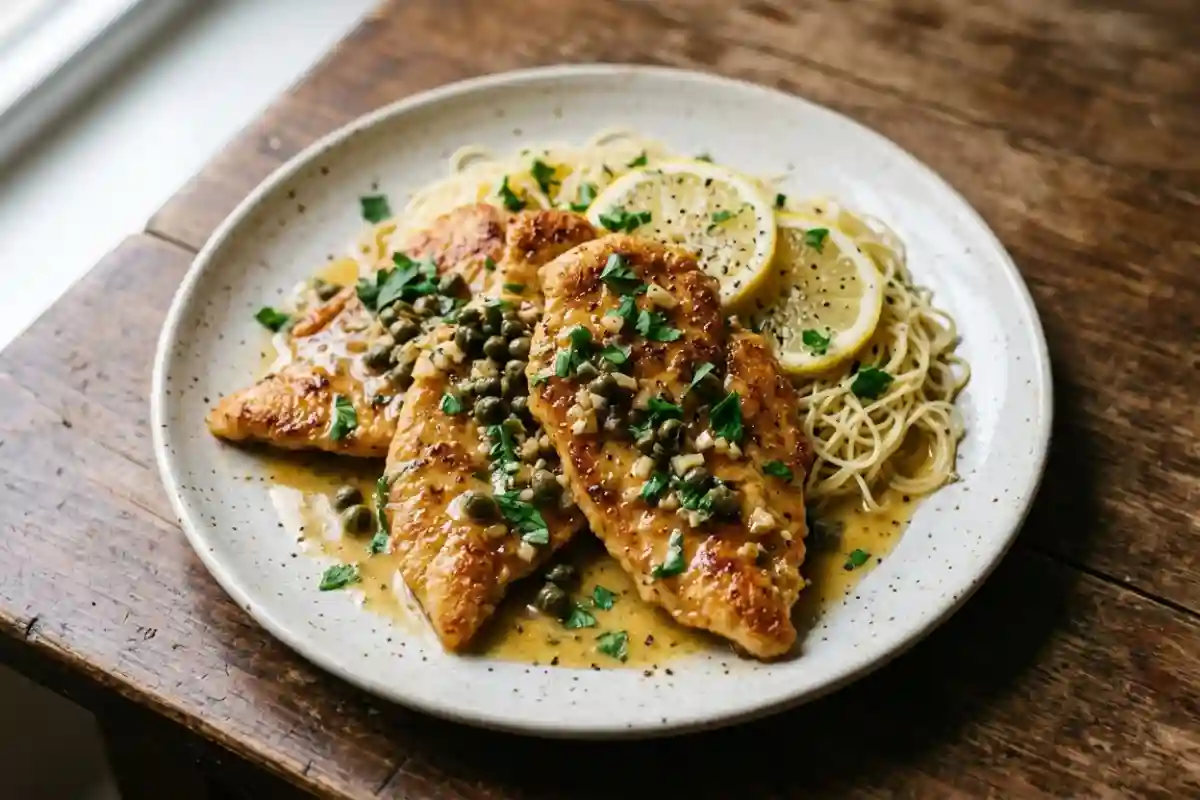
- Plate and Garnish: Transfer the cutlets to plates or a serving platter and spoon the lemon-caper sauce generously over the top. Scatter the chopped flat-leaf parsley over everything and lay lemon rounds alongside.
Notes
- Storage: Cool the cutlets completely before transferring them to an airtight glass or BPA-free plastic container. Store the chicken and sauce together, refrigerated, for up to 3 days. The sauce will thicken in the fridge as it chills but loosens again when reheated gently.
- Reheating: Warm the chicken and sauce in a covered skillet over low heat at 90°C / 195°F for 4 to 5 minutes, adding 1 to 2 tablespoons of chicken broth if the sauce has thickened too much. Avoid the microwave if possible; it toughens pounded chicken breast quickly. Confirm the internal temperature reaches 74°C / 165°F before serving.
- Make-Ahead: The chicken cutlets can be pounded and stored raw, covered in plastic wrap, in the refrigerator for up to 24 hours before cooking. The lemon-caper sauce can also be made up to 2 hours in advance and held at room temperature, then gently rewarmed in the pan before adding the seared chicken in the final step.
- Substitution: For a gluten-free version, substitute the all-purpose flour dredge with fine white rice flour or a certified gluten-free all-purpose blend at a 1:1 ratio. The rice flour crust is slightly more delicate but still produces a good golden sear. If capers are unavailable, finely chopped green olives provide a similar briny counterpoint to the lemon butter sauce.
FAQ
Why is my chicken piccata sauce not thickening?
The piccata sauce thickens through two mechanisms: reduction and butter emulsification, not starch. If the sauce is too thin, it likely needs more time over medium-high heat to reduce the white wine and chicken broth before you add the butter. Let the liquid simmer for the full 3 minutes and watch for that slight glossiness before pulling the pan off the heat. Adding cold butter off the heat and swirling rather than stirring is essential – heat breaks the emulsion and leaves you with greasy, separated liquid instead of a cohesive sauce. If it still looks thin, a quick 30-second simmer after returning the pan to the heat will bring it together.
Can I make chicken piccata without wine?
Yes. Replace the dry white wine with an equal volume of low-sodium chicken broth and add an extra teaspoon of lemon juice to compensate for the acidity that wine contributes to the sauce. Some cooks also add a small splash of white wine vinegar, about half a teaspoon, to replicate that fermented tartness. The sauce will be slightly less complex in flavor but still entirely cohesive and bright. The key is still deglazing the pan immediately after searing to lift the fond, which is where much of the savory depth comes from regardless of the liquid used.
What is the difference between chicken piccata and chicken francese?
Both dishes use pounded, thin chicken breast cutlets and finish in a lemon-forward pan sauce, but the preparation of the cutlet differs significantly. Chicken francese dips the cutlet in seasoned egg before dredging in flour, creating a slightly thicker, eggy coating that is more tender and custardy after cooking. Chicken piccata uses only flour, which crisps into a light, golden crust. The sauce for piccata always includes capers, which are absent from francese. Francese sauces are sometimes slightly sweeter or built with butter and lemon alone, while piccata has a sharper, brinier flavor profile driven by the caper brine and the higher proportion of lemon juice.
How do I keep the flour coating from falling off during searing?
Three things cause the dredge to fall off: excess moisture on the chicken surface, too much flour left on the cutlet, and a pan that is not hot enough when the chicken goes in. Pat the chicken completely dry with paper towels before seasoning, shake off every bit of excess flour after dredging, and let the coated cutlets rest on a plate for 2 minutes before they hit the pan. The oil should be shimmering and just starting to show faint wisps of smoke before you lay the cutlets down. Once they are in the pan, resist the urge to move them for the full 3 minutes – the crust will release naturally from a properly preheated stainless steel pan once it has set.
Is chicken piccata high in sodium, and can I reduce it?
As written, chicken piccata sits at around 480mg of sodium per serving, which is moderate. The primary sources are the capers, the chicken broth, and any salt added during seasoning. Using low-sodium chicken broth and rinsing the brined capers under cold water for 30 seconds before adding them will meaningfully reduce the sodium content without eliminating the flavor they contribute. Cutting the capers in half and supplementing with a small amount of lemon zest is another approach that maintains the brininess at lower sodium levels. Salt-packed capers, rinsed thoroughly, are actually lower in sodium than brine-packed ones and deliver a firmer texture.
What should I serve with chicken piccata?
The lemon-caper pan sauce needs something to pool over or soak into, so starchy sides work best. Angel hair pasta tossed with a small amount of olive oil is the most traditional pairing in Italian-American cooking, and its thin strands coat quickly in the sauce without competing with the chicken. Orzo, polenta, or roasted baby potatoes are equally well-suited. For a lower-carbohydrate plate, roasted asparagus or sauteed spinach with garlic absorbs the sauce well and echoes the Italian flavors of the dish. A dry, high-acid white wine such as Pinot Grigio or Sauvignon Blanc works with the same flavor compounds that are already in the sauce.