
Chicken Alfredo is a pasta dish built on a rich Parmesan cream sauce tossed with fettuccine and sliced seared chicken breast. The cooking method combines stovetop sauteing for the chicken with a saucepan reduction for the Alfredo base. The dish draws from Italian-American cuisine, where the original Roman burro e parmigiano preparation evolved into the cream-enriched version common in the United States.
One serving of Chicken Alfredo provides approximately 52 grams of protein and 680 calories. The dish qualifies as a high-protein meal and suits those following no specific dietary restriction, though it contains gluten and dairy. Chicken Alfredo fits weeknight dinners and casual family meals where a filling, single-pan pasta satisfies multiple appetites without long preparation.
This recipe pairs naturally with a side of sauteed chicken and vegetables for a complete plate. The technique here uses heavy cream reduced directly in the skillet after searing the chicken, which allows the rendered fond to enrich the sauce with deeper savory flavor.
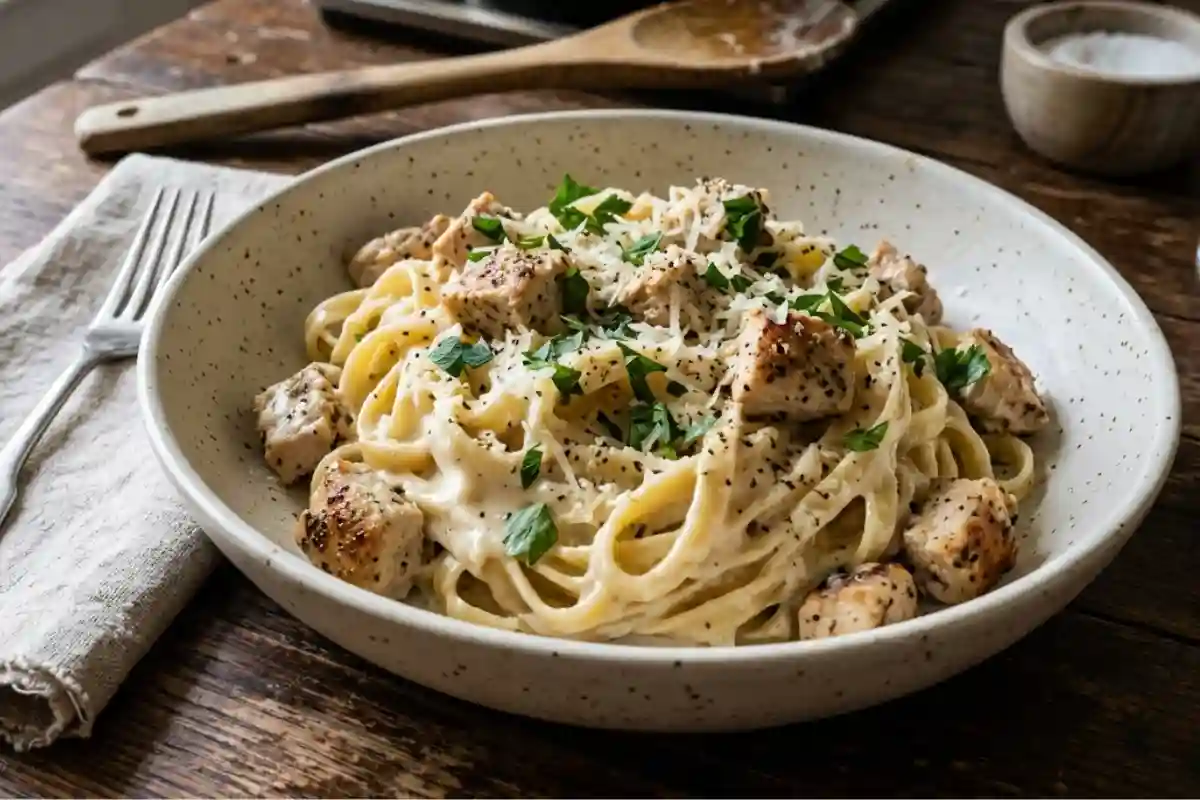
Chicken Alfredo
Ingredients
Equipment
Method
- Slice and Season Chicken: Place each chicken breast flat on a cutting board and slice it horizontally through the center to create two even cutlets of equal thickness. Pat all four cutlets completely dry with paper towels, removing as much surface moisture as possible. Season both sides of each cutlet evenly with 1 teaspoon of kosher salt and 0.5 teaspoon of black pepper. Dry, well-seasoned chicken forms a proper sear in the skillet rather than steaming against the pan surface.
- Boil Salted Pasta Water: Fill a large pot with 4 liters / 1 gallon of water and bring it to a full rolling boil over high heat, approximately 12 minutes. Add 1 tablespoon of kosher salt directly to the boiling water. Heavily salted water seasons the fettuccine from within the pasta strand rather than only at the surface after plating.
- Sear the Chicken Cutlets: Heat 2 tablespoons of olive oil in a 12-inch stainless steel skillet over medium-high heat for 2 minutes until the oil shimmers and a drop of water evaporates immediately on contact. Place two cutlets flat in the skillet and cook for 4 minutes without pressing or moving them until the undersides develop a deep golden crust that releases cleanly from the pan. Flip each cutlet with tongs and cook the second side for 3 minutes until the internal temperature reads 74°C / 165°F on an instant-read thermometer inserted into the thickest point. Transfer the cooked cutlets to a clean cutting board and repeat with the remaining two cutlets. Rest all four cutlets for 5 minutes before slicing.
- Cook the Fettuccine: Add the dry fettuccine to the boiling salted water and cook for 9 minutes, stirring once at the 3-minute mark to prevent the strands from clumping together, until the pasta is al dente with a slight resistance at its center when bitten. Before draining, ladle 120ml / 0.5 cup of the starchy pasta cooking water into a heatproof measuring cup and set it aside. Drain the fettuccine through a colander and do not rinse it, as the surface starch helps the Alfredo sauce adhere to each strand.
- Build the Alfredo Sauce: Reduce the heat under the same skillet used for searing to medium and add 2 tablespoons of unsalted butter. Once the butter melts completely and begins to foam, add the minced garlic and cook for 1 minute, stirring constantly with a wooden spoon, until the garlic is fragrant and pale gold. Pour in 240ml / 1 cup of heavy cream and stir it into the butter and garlic mixture. Cook the cream for 4 minutes, stirring every 30 seconds, until it reduces slightly and coats the back of the wooden spoon in a thin, even layer.
- Finish with Cheese and Pasta: Remove the skillet from the heat completely before adding the Parmesan. Add the 100g / 3.5oz of grated Parmigiano-Reggiano in two batches, stirring each addition in a circular motion until the cheese melts fully into the cream and no visible shreds remain. Add the 0.25 teaspoon of nutmeg and stir to incorporate. Add the drained fettuccine directly to the skillet and toss the pasta through the sauce using tongs for 1 minute, adding the reserved pasta water 2 tablespoons at a time until the sauce reaches a smooth, glossy consistency that clings to every strand. The sauce should coat the pasta without pooling at the bottom of the pan.
- Slice Chicken and Plate: Slice the rested chicken cutlets on the cutting board into strips approximately 1.5cm / 0.6in wide, cutting against the grain of the muscle fibers. Divide the fettuccine Alfredo evenly among four wide, shallow bowls using tongs. Arrange the sliced chicken strips over the top of each portion. Garnish each bowl with a pinch of chopped flat-leaf parsley and a light dusting of additional grated Parmesan. Serve immediately while the sauce remains fluid and the pasta is at full temperature.
Notes
- Storage: Transfer cooled Chicken Alfredo to an airtight container and refrigerate for up to 3 days. Store the sliced chicken and pasta together, as the sauce helps keep the chicken moist during refrigeration
- Reheating: Place a single serving of refrigerated Chicken Alfredo into a small saucepan over low heat. Add 2 tablespoons of water or whole milk and stir continuously for 4 minutes until the sauce re-emulsifies and the internal temperature of the chicken returns to 74°C / 165°F. Avoid high heat, which causes the cream sauce to break and separate into a greasy, grainy texture.
- Make-Ahead: Sear and slice the chicken up to 24 hours in advance and refrigerate it in an airtight container. Cook the pasta and prepare the Alfredo sauce fresh when ready to serve. Pre-cooked pasta absorbs the sauce too quickly when left together for extended periods.
- Substitution: Replace the heavy cream with full-fat evaporated milk for a lighter sauce with fewer calories per serving. Use the same quantity of 240ml / 1 cup and reduce for the same 4 minutes. The sauce will be slightly thinner than the cream version but will still coat the fettuccine.
- Freezing: Freeze the seared, sliced chicken separately from the pasta in a freezer-safe bag for up to 2 months. The cream-based Alfredo sauce does not freeze well, as it separates upon thawing. Thaw the chicken overnight in the refrigerator and prepare fresh sauce and pasta when ready to serve.
- Sauce Rescue: If the Alfredo sauce breaks and appears greasy or grainy, remove the skillet from the heat immediately. Whisk in 2 tablespoons of cold heavy cream in a slow, steady stream while stirring vigorously. The cold fat reintroduces an emulsification point and brings the sauce back to a smooth consistency within 1 minute.
FAQ
What is Chicken Alfredo?
Chicken Alfredo is an Italian-American pasta dish consisting of fettuccine tossed in a Parmesan cream sauce topped with sliced seared chicken breast. The dish originates from a Roman preparation called fettuccine al burro, made with butter and Parmigiano-Reggiano, which American cooks later enriched with heavy cream. The version common in the United States includes a cream-reduced sauce and a full protein component in the form of seasoned, pan-seared chicken.
How do you keep Chicken Alfredo sauce from getting gummy?
Remove the skillet from the heat before adding the grated Parmesan, as direct heat causes the cheese proteins to tighten and clump rather than melt smoothly. Add the cheese in two batches, stirring each addition fully into the cream before adding the next. Starchy pasta water added 2 tablespoons at a time helps the sauce stay fluid and glossy as the fettuccine finishes in the pan.
What internal temperature should chicken reach in Chicken Alfredo?
The chicken must reach an internal temperature of 74°C / 165°F, measured with an instant-read thermometer inserted into the thickest point of the cutlet. This temperature eliminates Salmonella and Campylobacter, the two bacterial pathogens most commonly associated with raw poultry. Checking the temperature is especially important when cooking thin, horizontally-sliced cutlets, as surface color alone is not a reliable doneness indicator.
Can you make Chicken Alfredo without heavy cream?
Full-fat evaporated milk, whole milk combined with cream cheese, or a cashew cream blend each serve as substitutes for heavy cream in an Alfredo sauce. Full-fat evaporated milk produces the closest result, with a similar richness and a comparable reduction time of 4 minutes over medium heat. Whole milk thins the sauce significantly unless combined with 60g / 2oz of softened cream cheese stirred in with the Parmesan.
How long does Chicken Alfredo last in the refrigerator?
Chicken Alfredo keeps in an airtight container in the refrigerator for up to 3 days. After this point, the cream sauce continues to absorb into the pasta and the fat in the sauce begins to separate from the liquid, degrading both texture and flavor. Reheat single portions in a saucepan over low heat with a small amount of added liquid rather than in a microwave, which generates uneven heat and causes the cream emulsion to break.
What pasta works best for Chicken Alfredo?
Fettuccine is the traditional pasta for Alfredo sauce because its wide, flat surface area holds the cream and Parmesan coating across the full length of each strand. Linguine works as a narrower substitute with similar strand-pasta properties. Penne and rigatoni are also common in American variations, where the tubular shapes trap sauce inside the pasta cavity for a different but effective coating result.
What do you serve with Chicken Alfredo?
Garlic bread, a crisp green salad, or roasted broccoli each complement Chicken Alfredo by providing textural contrast against the creamy pasta. A Caesar salad in particular pairs well because its acidic dressing cuts through the richness of the Parmesan cream sauce. For a more complete plate, roasted asparagus or sauteed spinach add vegetable volume without competing with the flavors of the Alfredo base.
Can you make Chicken Alfredo ahead of time for meal prep?
Chicken Alfredo works as a high-protein meal prep option when the components are stored separately. Portion the seared, sliced chicken into individual airtight containers and refrigerate for up to 3 days. Prepare the fettuccine and Alfredo sauce fresh on each serving day, as pre-combined pasta absorbs the sauce completely within a few hours and loses the creamy, fluid texture of a freshly finished dish.