
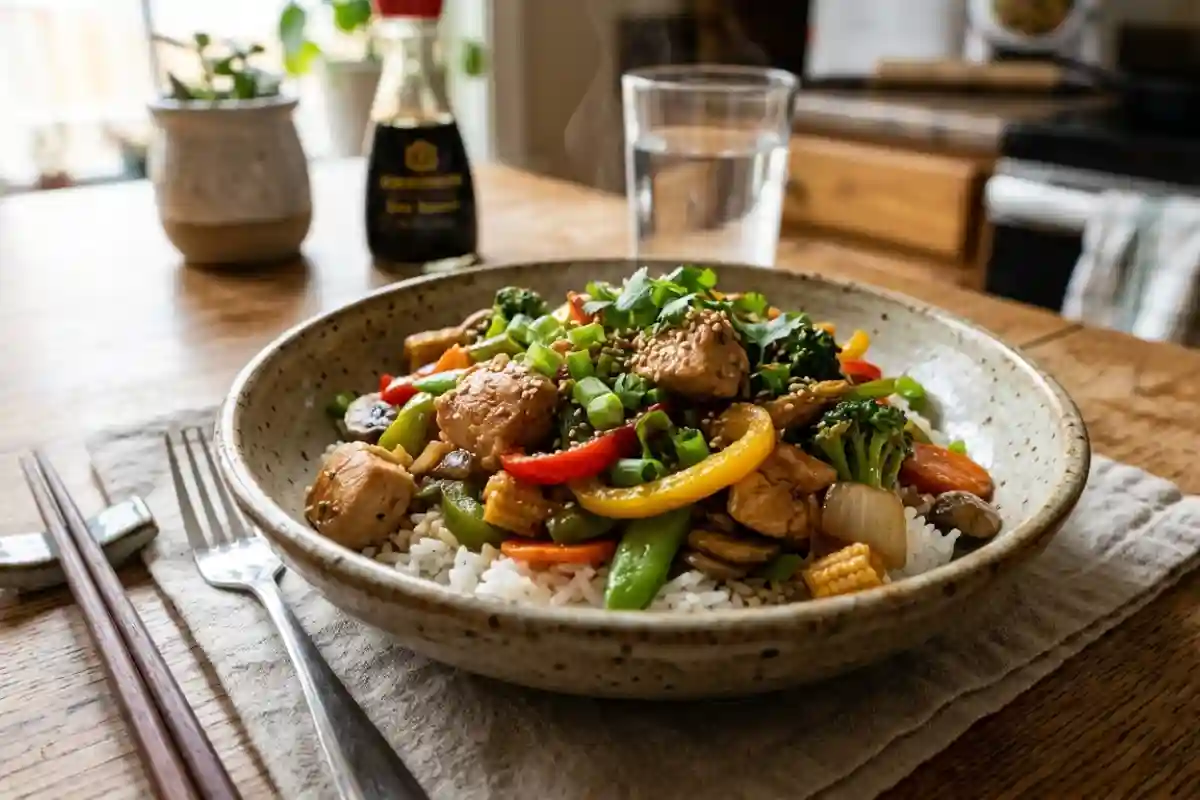
Chicken Stir-Fry is a high-heat saute dish rooted in Chinese cooking technique, built around bite-sized strips of boneless chicken breast cooked rapidly in a wok or skillet alongside crisp vegetables and a savory sauce. The method relies on a concept known as wok hei, the slightly smoky, caramelized quality that develops when protein and aromatics hit an intensely hot cooking surface. Every element moves fast: the chicken sears in under 4 minutes, the vegetables stay vivid and snappy, and the sauce reduces to a glossy coat in seconds.
A single serving of chicken stir-fry delivers roughly 38 grams of protein at approximately 320 calories, making it a reliable choice for high-protein meal planning without excess fat. The dish is naturally dairy-free and can be made gluten-free by swapping soy sauce for tamari. It suits weeknight dinners when time is short, and it holds well for meal prep through the week.
For a lower-carb variation, this recipe pairs naturally with cauliflower rice in place of jasmine rice. A wok is the ideal vessel here, though a 12-inch stainless steel skillet produces results that are nearly as good when the pan is preheated aggressively.
Chicken Stir-Fry Recipe
Ingredients
Equipment
Method
- Velvet the Chicken: Combine the chicken strips, 2 tablespoons of cornstarch, and 1 tablespoon of soy sauce in a medium bowl. Toss until every piece is evenly coated and the cornstarch has no dry pockets remaining. Let the mixture rest at room temperature for 10 minutes. This velveting step, borrowed directly from Chinese restaurant technique, forms a thin protective coating that keeps the chicken moist and tender even under intense wok heat.
- Mix the Stir-Fry Sauce: Whisk together the oyster sauce, remaining 1 tablespoon of soy sauce, rice vinegar, toasted sesame oil, honey, water, and 1 teaspoon of cornstarch in a small bowl until the slurry is fully dissolved and no lumps remain. Set the bowl within arm's reach of the stove before you begin cooking. Once the wok is hot, the sauce goes in fast, so having it ready prevents the vegetables from overcooking while you search for ingredients.
- Sear the Chicken: Heat a wok or 12-inch skillet over high heat until the surface just begins to show faint wisps of smoke, which takes approximately 2 minutes. Add 1 tablespoon of neutral oil and swirl to coat the cooking surface. Add the velveted chicken strips in a single layer and sear undisturbed for 2 minutes until the undersides are golden and the edges have turned opaque. Flip the strips and cook for 1 additional minute until the internal temperature reaches 74°C / 165°F. Transfer the chicken to a clean plate and do not clean the pan.
- Saute the Aromatics and Vegetables: Return the unwashed pan to high heat and add the remaining 1 tablespoon of oil. Add the garlic and ginger together and stir constantly for 30 seconds until the mixture is fragrant and just beginning to turn golden at the edges. Add the broccoli florets first, followed by the bell pepper strips and snap peas, and toss everything vigorously using a spatula or wok spoon for 3 minutes. The broccoli should turn a vivid emerald green and the peppers should be tender at the edges while still holding a slight snap in the center.
- Combine and Glaze: Return the seared chicken strips to the pan and pour the sauce over everything in one steady motion. Toss and stir continuously for 90 seconds over high heat until the sauce thickens to a glossy, clinging consistency and coats every piece of chicken and vegetable. If the sauce tightens too fast, add 1 tablespoon of water and toss again. Remove the pan from the heat the moment the glaze is shiny and uniform, since another 30 seconds on high heat can cause the sauce to seize and turn sticky.
- Garnish and Serve: Transfer the stir-fry to a large serving platter or divide directly into bowls. Scatter the sliced scallions and toasted sesame seeds evenly over the top. Serve immediately while the vegetables are still vivid and the sauce is at its glossiest. Chicken stir-fry loses its textural contrast quickly as residual heat continues to soften the vegetables, so plating and serving within 2 minutes of leaving the heat preserves the best result.
Notes
- Storage: Transfer cooled stir-fry to an airtight glass or BPA-free plastic container and refrigerate for up to 3 days. Store the stir-fry separately from any cooked rice to prevent the rice from absorbing the sauce and becoming gummy.
- Reheating: Reheat refrigerated stir-fry in a skillet over medium-high heat at approximately 180°C / 350°F surface temperature, stirring frequently, for 3 to 4 minutes until the chicken returns to an internal temperature of 74°C / 165°F. Add 1 tablespoon of water to the pan before heating to loosen the sauce and restore its glossy texture.
- Freezing: Freeze cooled stir-fry in a zip-top freezer bag with the air pressed out for up to 2 months. Thaw overnight in the refrigerator before reheating; note that bell peppers and snap peas will soften considerably after freezing, so this method is best when texture is not the priority.
- Make-Ahead: Slice the chicken, prepare the sauce, and cut all vegetables up to 24 hours in advance. Store the chicken and vegetables in separate airtight containers in the refrigerator and keep the sauce covered in a small jar. The entire dish can then be cooked from cold ingredients in under 15 minutes.
- Substitution: Boneless skinless chicken thighs work equally well and stay slightly more tender under the high heat of the wok. Swap the broccoli for broccolini, snow peas, or sliced zucchini at the same cook time and quantity. For a gluten-free version, replace both the soy sauce and oyster sauce with tamari and gluten-free oyster sauce respectively.