

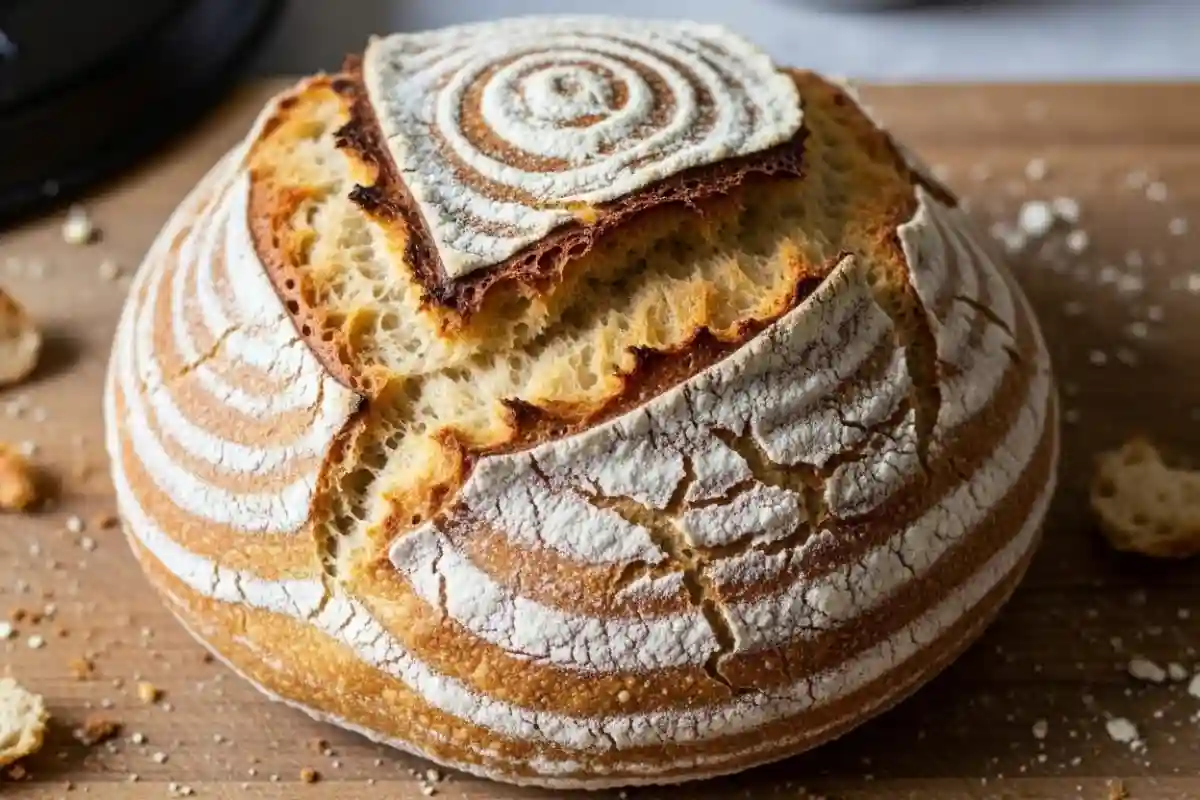
Simple Crusty White Bread is an American artisan-style loaf made with bread flour, yeast, salt, and water, then baked in a Dutch oven for a chewy crumb and crisp crust. The dough comes together quickly in one bowl as a sticky, rough mass, then rests and ferments until full of air and flavor. After a gentle shape and short second rest, the dough drops into a screaming-hot Dutch oven where steam builds during the covered bake, giving strong oven spring. The lid comes off to brown the crust, creating a rustic round loaf with a crackly exterior and open, tender interior.
Simple Crusty White Bread Recipe
Simple Crusty White Dutch Oven Bread is an American artisan loaf made with bread flour, yeast, salt, and water, shaped after a long rest and baked in a hot Dutch oven for an open crumb and crisp, crackly crust.
Ingredients
Equipment
Method
Mix the dough
- Add bread flour, yeast, and salt to a large mixing bowl and stir with a wooden spoon until the dry ingredients look evenly combined.
- Pour in the water with a measuring cup and stir with the wooden spoon until a sticky, shaggy dough forms and no dry flour remains on the sides or bottom of the bowl.
- Cover the bowl tightly with plastic wrap or a lid and let it sit at room temperature for 12 to 16 hours so the dough slowly rises and develops bubbles.
Check fermentation and prep for shaping
- After the rest, uncover the bowl and check that the dough has expanded and the surface is dotted with bubbles and looks slightly jiggly when you move the bowl.
- Place a sheet of parchment paper on the counter and dust it lightly with flour using your fingers.
Shape the loaf
- Dust the top of the dough in the bowl with a light sprinkle of flour, then use your hand or a spatula to gently loosen the dough from the sides.
- Tip the dough out onto the floured parchment, letting it fall in one piece.
- With lightly floured hands, gently pull the edges of the dough into the center to form a rough ball, then flip the dough so the seam side is down and the smooth side faces up.
- Cup your hands around the dough and gently pull it toward you on the parchment to create surface tension and a round, tight shape without pressing out the gas.
Second rest and preheat the Dutch oven
- Cover the dough on the parchment with a clean kitchen towel and let it rest at room temperature for 40 minutes so it puffs slightly.
- About 20 minutes before baking, place the empty Dutch oven with its lid on into the oven and preheat the oven to 450°F so the pot becomes very hot.
Transfer and bake covered
- When the dough has rested, carefully remove the hot Dutch oven from the oven with oven mitts and set it on a heat-safe surface.
- Use the parchment edges to lift the dough and lower it into the hot Dutch oven, keeping the parchment under the dough.
- If you like, make a shallow slash across the top of the dough with a sharp knife for controlled expansion, then cover the Dutch oven with the lid.
- Place the covered Dutch oven on the middle rack and bake at 450°F for 30 minutes so the loaf steams and rises.
Finish uncovered
- Remove the lid with oven mitts and continue baking the loaf uncovered for 15 minutes until the crust is deep golden brown and sounds hollow when you tap it.
- Take the Dutch oven out with oven mitts, lift the bread out by the parchment, and place it on a rack or cutting board to cool for at least 30 minutes before slicing.
Notes
- The dough should feel very sticky and loose after mixing; avoid adding more flour so the loaf keeps its open crumb and light texture.
- A cooler room leans closer to the 16-hour end of the fermentation range, while a warmer room may be ready around 12 hours; always look for bubbles and volume increase.
- The crust stays crisp when cooled but will soften slightly if stored in a bag; re-crisp slices in a 350°F oven or toaster before serving.